
What Are the Orthodox Options?
In this book I am urging you to look again and carefully at what the Bible says about eschatology. Before, however, we can begin that study, the problem suggested by the question in the above heading must be addressed. In the first section of this general introduction, I have drawn a clear distinction between the orthodox core of eschatology and those views of prophecy that cannot be accepted as Christian in any sense.
Four views fall within the general boundaries of orthodox Christianity. By calling these four views “orthodox options,” I do not, of course, mean that they are equally biblical or confessional. All error is serious—even disagreements among orthodox Christians. This book intends to help you choose between these generally orthodox (but not equally biblical) options. What then are these options, and how do they disagree?
The Options Explained
The prophetic view widely popular today is called dispensation- alism, or more fully, dispensational premillennialism. This is the first of the “orthodox” options.
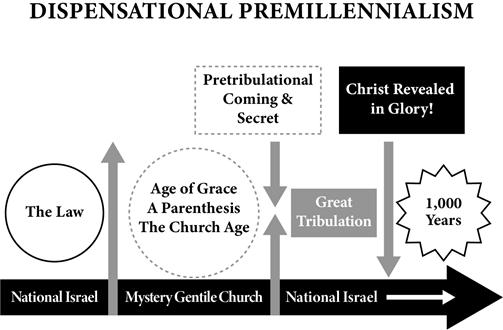
Dispensational premillennialism (as this name suggests) is a form of premillennialism. Premillennialism is the view that Christ is to return before the millennium prophesied in Revelation 20:1–10. The term, millennium, is simply the Latin for one thousand years. The one thousand years of Revelation 20 is a time in which Christ reigns and Satan is bound.
Premillennialists take this thousand years to mean a personal and physical reign of Christ on earth after He returns for a literal one thousand years. Dispensational premillennialism is the form of premillennialism that emphasizes that history is divided into different dispensations. Of course, all Christians—no matter their eschatological persuasion—allow that in some sense this is true. Dispensationalism is, thus, more specifically the view that God is pursuing alternating programs in these different dispensations. As the chart above suggests, God alternately pursues His plan for the Jewish nation, on the one hand, and His plan for the gentiles and the church on the other.
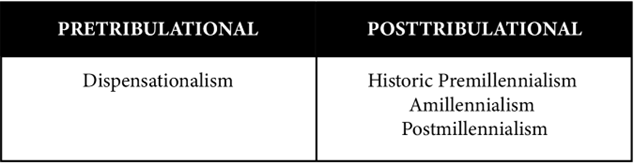
The secret rapture theory of Christ’s second coming is closely related and, in fact, built on this dispensational scheme of history. This theory (spectacularly popularized by the special effects of recent movies) is the view that Christ’s return will be in two stages. The first of these two stages will be secret and will remove the church from the world prior to the “great tribulation.” The second will be glorious and will bring an end to the reign of the antichrist and usher in the millennial reign of Christ with the Jewish nation over the world.
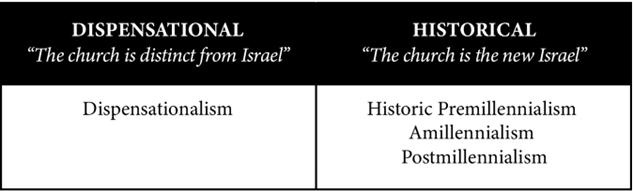
It is important to emphasize that the unique and distinguishing feature of dispensationalism is that it consistently maintains a separation between Israel and the church. This is called the Church-Israel distinction. It is this point that most clearly distances dispensational premillennialism from the next view to be described. That view is often called historic or covenant premillennialism.
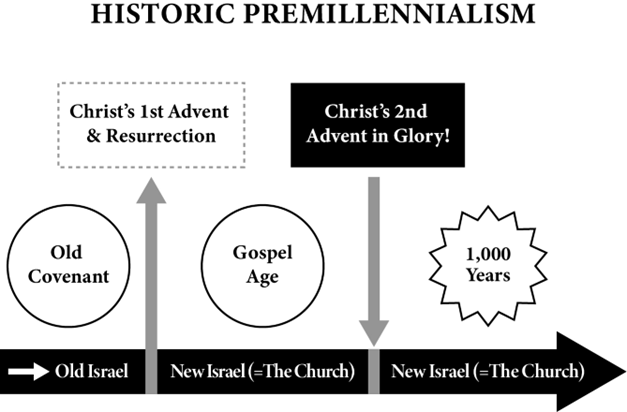
This view holds, in common with dispensationalism, a premi- llennial view of Christ’s return. Premillennialism, as just noted, is the view that says that Christ is to return before the millennium prophesied in Revelation 20:1–10.
The name, historic premillennialism claims for this view that it is the premillennialism found earlier in the history of the church. It implicitly claims that dispensationalism is not to be identified with the premillennialism found in the early centuries of church history. This claim will be examined later in this volume.
This view has also sometimes been called covenant premillen- nialism. The name, covenant premillennialism, associates this form of premillennialism with covenant theology. This name emphasizes that this form of premillennialism does not separate Israel and the church in the way that dispensationalism does. Rather, it sees the church as the new Israel of God and rejects the Church-Israel distinction of dispensationalism. It follows that rejecting this distinction, this form of premillennialism, also rejects the secret rapture theory built upon it.6 Note the table of differences below.
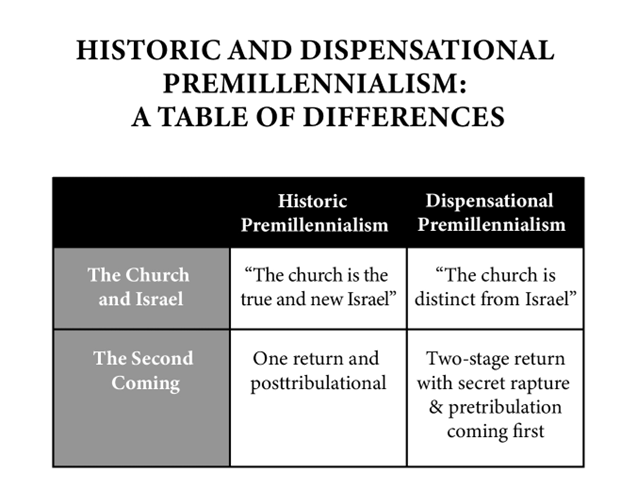
6 In the interest of accuracy, it must be said that there are some who claim to be dispensationalists, but who do not hold to the secret rapture theory. Because they do not hold the Church-Israel distinction foundational to it, there are no historic premillennialists that hold the secret rapture theory. At least, I am not aware of any. As the charts indicate, I believe that the characteristic view of dispensationalism is the secret rapture theory.
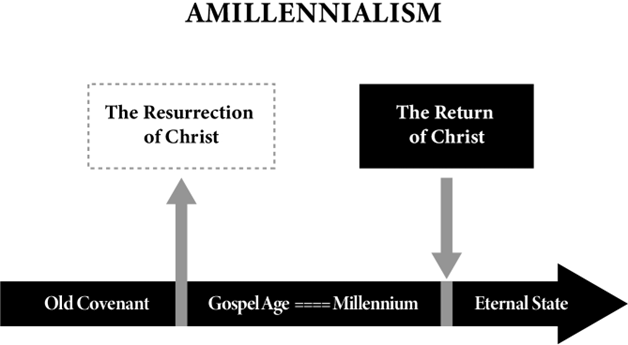
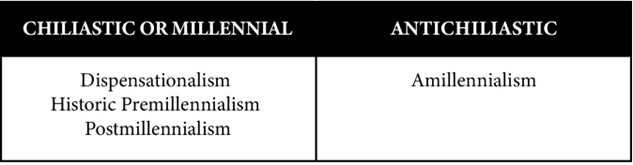
Amillennialism literally means no millennialism. In one sense this name is accurate, and in another it is not. It is accurate in that the millennium has usually been defined as a great golden age of material blessing on earth before the eternal state in which evil is suppressed and righteousness is triumphant. It is true that in this sense amillennialism holds no millennium. Amillennialists, however, are Bible-believing Christians and view Revelation 20:1–10 as divine truth. Thus, they do believe in the millennium of Revelation 20 and associate this period of time with the gospel or church age between Christ’s first and second advents. They teach, consequently, that Christ returns after this mil- lennium is completed. At His return the general judgment and general resurrection occur and the eternal state commences.
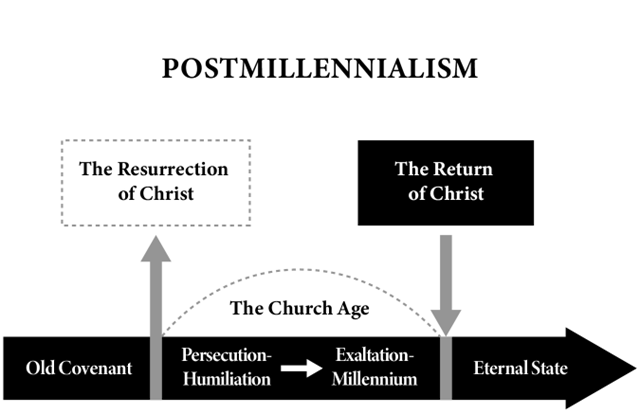
Postmillennialism, as the name indicates, teaches that Christ will come back after the millennium. Post is the Latin preposition for after. In contrast to amillennialism it does believe in a great, golden age of spiritual and material blessing on earth before the eternal state. In contrast to premillennialism it believes that this great golden age is brought to pass through spiritual means before the return of Christ.
The Options Compared
These are the four views of eschatology that Christians have historically held and presently hold. These millennial views can be classified in different ways. They can be classified by their view of the
relation of the return of Christ to the millennium. (Note that in this narrow sense amillennialism is in a sense postmillennial).

They may also be classified by means of the relation of Christ’s return to a future tribulation.
These views may also be classified by way of their view of the relation of the church and Israel.
Finally, these views may be categorized by way of their view of a future millennium before the eternal state. Millennialism is sometimes called chiliasm.
This brief overview shows that dispensationalism is not the only view held by evangelical Christians. The idea that if the popular view held today is wrong, then the Christian church has been wrong, assumes something that is simply mistaken. All of the above views are held by evangelical Christians today.
Each of the views discussed above, with the exception of dis- pensationalism, has been widely held by Christians in past centuries of the church. Granted, dispensationalism is prominent in our day, but each of the other views has had its day in the church. Historic premillennialism was quite prominent for a period in the early church. It was also prominent for a period in the 1800’s. Amillennialism was dominant in the church from the time of Augustine (who died in 430) through the 1500’s and the early Reformation period. Augustine, Luther, and Calvin were each amillennialists. Postmillennialism was widely held in the 1600’s and 1700’s by some of the great, evangelicals of the day like Jonathan Edwards. What is my point? Among other things it is that dispensational premillennialism is not the only Christian alternative! To say that dispensationalism is wrong is not to say that Christianity is mistaken about the core truths of the doctrine of last things. There are other Christian alternatives.